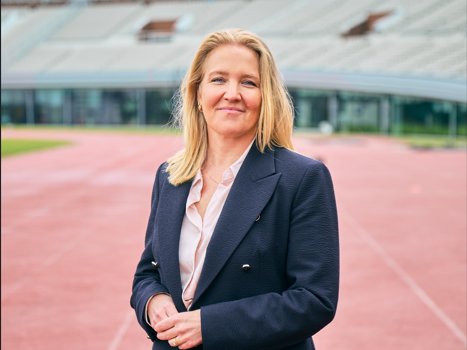
BOUWINVEST: HELPING TO BUILD A HEALTHIER ZUIDAS
“A healthy city isn’t just about sustainable buildings,
but above all about how people live, move and connect within them.”
Annemarie Maarse, COO at Bouwinvest Real Estate Investors.
Zuidas is swiftly taking shape as an increasingly multifaceted urban district where living, working, socialising and leisure all come
together. From the Olympic Stadium area, Annemarie Maarse is watching these developments from close by. Recently appointed COO of
Bouwinvest – a real estate investment manager for clients such as pension funds – she oversees the organisation’s real estate activities
both in the Netherlands and internationally. Speaking to Hello Zuidas, she discusses the transformation of Olympic Amsterdam, the
importance of healthy living environments as a driver of long-term financial value, and her vision for the future of Zuidas.
For readers who may not know you yet, could you tell us a little about yourself and your role as COO of Bouwinvest?
“I’ve been with Bouwinvest for nearly two years now. I became COO in November, and previously was head of asset management. I’ve worked in institutional real estate since 2011, first at Altera Vastgoed and later at Achmea Real Estate. Real estate has always fascinated me precisely because it’s so closely linked to wider societal developments. At Bouwinvest, I’m in charge of the organisation’s entire real estate division. We manage property investment portfolios for pension funds and other clients in the Netherlands, and internationally in association with partners in Europe, Southeast Asia, Australia and North America. And it’s not just real estate – we look at innovation, data and the future of cities as well. Client Services and Business Technology also fall under my responsibility. This mix makes my role incredibly dynamic.”
You think about the future of real estate and urban areas every day. What aspects of Zuidas’ development are most interesting to you personally?
“I distinctly remember visiting Zuidas for the first time as a student in the late 1990s, when there was barely anything. We were asked to imagine how the area might develop into an international business centre. Looking at what has emerged since then, it’s quite impressive. Zuidas has grown into a multifunctional area with housing, employment and mobility. What I particularly admire is that it feels really alive now. Things are happening at every moment of the day, creating a pleasant energy, vibrancy and sense of social safety. And, despite the scale of the buildings, it still has a human feel. Because of that, Zuidas is not only a strong urban environment, but also a place that delivers long-term value for our clients.”
Bouwinvest has a strong portfolio in and around Zuidas, including Hourglass, The Olympic Stadium, The Garage and Move. How do these kinds of buildings contribute to a healthy and liveable city?
“I think it’s really marvellous what has emerged here in Olympic Amsterdam. Fifteen years ago it was a rather stark and anonymous area. Now, it’s a buzzing urban district mingling residents, businesses and visitors. I think this mix of functions is really its strength. You have residential buildings, offices, a wide range of retail with cafes and restaurants, sport facilities and places for people to meet, which is what makes an area appealing and resilient over the long term. Buildings never exist in isolation. What matters is how the neighbourhood works and reinforces itself as a whole. The way the ground-floor spaces are activated also plays an important role, with places where people can meet, exercise or simply hang out, so there’s activity seven days a week.”
The theme of this issue is The Healthy City. How does Bouwinvest define a healthy city?
“A healthy city starts with sustainable buildings, but this alone isn’t enough. A healthy city is also about wellbeing, social safety, greenery, air quality, accessibility and social interaction. We firmly believe that these factors ultimately boost real estate values. More importantly, though, we’re creating places where people actually want to live and work. The Olympic Stadium area is a great example. The city is focusing on sports and exercise here. As an owner and investor, we’re working to align with that, and many stadium tenants are involved in sport or health in some way. We actively promote events, like concerts, sport events, and things for kids, that bring together local residents, tenants and visitors. This creates a real sense of community.”
These days, people expect more from locations than merely nice buildings. What trends are you seeing in the realm of healthy working and living environments?
“Increasingly, we’re seeing buildings functioning as little cities unto themselves. The focus has expanded beyond architecture and sustainability alone to include encompass and connection. Projects like The Pulse are a case in point. Biobased building, more extensive planting and multifunctionality are also gaining more attention. People want environments where they can work, exercise, relax and gather, and this mix is becoming increasingly important. Mobility is changing as well. In the Netherlands, we’re still very used to going everywhere by car, but cycling, walking and public transport are gaining ground in urban environments like Zuidas.”
Looking ahead ten years, how would you describe the ideal future Zuidas?
“I’m super optimistic about the future of this area. The major
infrastructure projects will be completed soon, accessibility
will be vastly improved and there will be more room for
greenery and high-quality public spaces. My hope is that
Zuidas will continue developing into a truly mixed urban
district where people come not only to work, but also to
relax, socialise and live. A place that feels international, while
retaining the distinctive flavour of Amsterdam. I think it’s
precisely this mix of ambition, dynamism and human scale that
make Zuidas strong.”
Text: Romy Lange
Fotografie: Caily Bobbie Jo